“This house is insane.”
“This is actually a dream.”
“I never thought I could love a home in Nashville
this much.”
When designer and hotelier Lyon Porter finally listed the Ziggurat House in East Nashville’s Little Hollywood, the response online (and off) was not reserved. It was not mixed. And it was not delayed.
Two days after the 2,448-square-foot property hit the market as a private exclusive, listed for $2.9 million, it was the talk of the town — and already under contract.
“You know, when I met with brokers when I was thinking about selling it, everyone was like, ‘You’re insane. This is less than 3,000 square feet. The market record’s like just over $500 a foot,'” Porter remembers. “And I was like, ‘Yeah, but I’m not selling it on a price (per square foot). I’m selling a piece of art.'”
Art and Commerce
For most residential architecture and design projects, “piece of art” would be a little hyperbolic. But the Ziggurat House stands apart, both in aesthetic and in the history of real estate in Nashville.
The sale closed at about $1,184 a square foot, more than four times the city’s median. And to Porter, the overwhelming reaction made a point about what’s possible — what’s appreciated — in Nashville home design.
“I think people can feel when there’s heart and soul put into something versus what we find all over, which is that developer finish of, like, ‘Hey, let’s make it feel luxury, put a brass pop in,'” he says. “But it’s all the same, and there’s very little risk, to make it sellable. This was the opposite. I did a Spanish Southwestern Gaudi-esque tile dream house.”
Porter approached the Ziggurat House like he was designing his dream house, specifically, drawing from his admiration for Catalan architect Antoni Gaudi, his love of the American Southwest. He approaches every residential project that way, he says, mixing personal taste with the eclectic instincts of a collage artist and the improvisation of a jazz musician — reacting to mood, moving in rhythm, leading and following with a smooth push and pull.
That jazz element is where collaborators are key, and here, architect Jamie Pfeffer and Red Rock Tileworks founder Lindsay Sheets rounded out the core band. Pfeffer and Porter had worked together before; Sheets was new, but jumped into trading fours with gusto.
“I’m playing a riff. She’s playing a riff. We’re going back and forth,” Porter says. “And then, you don’t know where the song’s going, but you’re in a flow. I mean, we reached so many points of these amazing inspirational moments.”
Because They Could
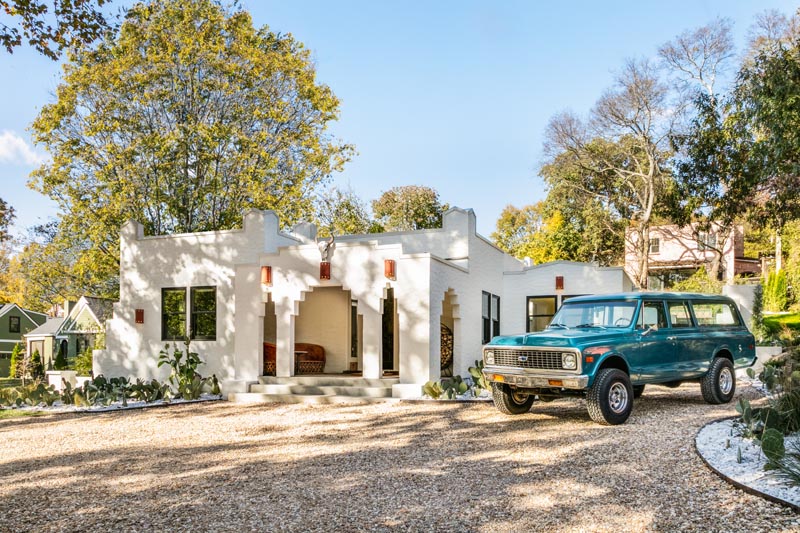
Little Hollywood, where the Ziggurat House sits, tucks back into a quiet, almost hidden corner of East Nashville. In the 1930s and ’40s, this stretch was stippled incongruously with a handful of stucco-wrapped, tile-roof-topped Spanish Eclectic homes, each a little different, all way out of step with the Victorians and bungalows on surrounding streets. Church L. Sexton and his family created the creative cluster because they wanted to and because they could, an expression of Church’s wife Nora Sexton’s love of the Southwest and old Spain.
Porter moved to Little Hollywood in 2014, and while he didn’t own one of the Sexton homes, he really, really wanted to. Just not, like, at this exact moment.
Neighbors had started a renovation, blowing out a bathroom and prepping to push out a back wall. But they had a wedding on the horizon, and budgets and focus couldn’t absorb two big projects. So the couple decided to sell their 1930 Spanish Revival home — specifically and only to Porter.
“I was building another project at the time,” Porter remembers, “and I didn’t need to do another project. But they’re like, ‘You have to buy this.'”
Locally, Porter had cemented a reputation for reimagining spaces with inspiration and devotion, starting with his Urban Cowboy hotel nearby on Woodland Street — a historic Victorian reborn as a Southwest Deco showpiece. Follow-up projects, from mod party palace the Dive Motel to Atomic Age-inspired hangout Eastside Bowl, spotlighted his range and rigor. Porter’s neighbors knew he could and would do magic with a home they loved but couldn’t manage. So they offered it for a steal.
He politely declined. They sweetened the deal.
“It’s one of the most special blocks, I think, in the United States, if not the world,” Porter says. “So I was like, ‘Um, I have to buy this, I guess.’ I felt like a steward — like, now I have to do something special with it.”
Breaking Rocks and Barriers
That something special started with careful, invested architecture.
Since Porter had history with Jamie Pfeffer, principal and architect at Pfeffer Torode, he was the first call. Pfeffer saw the potential too, and offered to partner.
But the property wouldn’t make the process easy. A small home on a short, sloped lot, it needed space, but expansion options were limited by nature, property lines, and a conservation overlay.
Pfeffer and Porter presented a concept, extending the home’s footprint like open arms wrapped around a sunny, central courtyard. The Historic Zoning Commission said no. They regrouped and appealed.
“I’m at the hearing with Jamie and the teams,” Porter remembers, “and the head of Historics is like, ‘Look at how beautiful this house is. They’re keeping the facade… Let them do it. This is gorgeous and it’ll be good for the neighborhood. And also, Little Hollywood is not contextual to anything.'”
Not common, not boring. Certainly not contextual to anything in Nashville.
It took the better part of a year to get it, but the green light came, and demolition, construction, and design began. That took another two years or so, from pulling down walls so weakened you could jam a finger through to hammering 16 feet of Tennessee limestone, then building back an old home with a new vision.
All in the Hands
Sheets came to the Ziggurat project after the walls came down. She was a fan of Porter’s work, having introduced herself at Urban Cowboy, mentioning that she’d love to collaborate.
“It was probably six or so months later that he had these projects, remembered that conversation, and came by the shop and was inspired,” she remembers. “And off we were.”
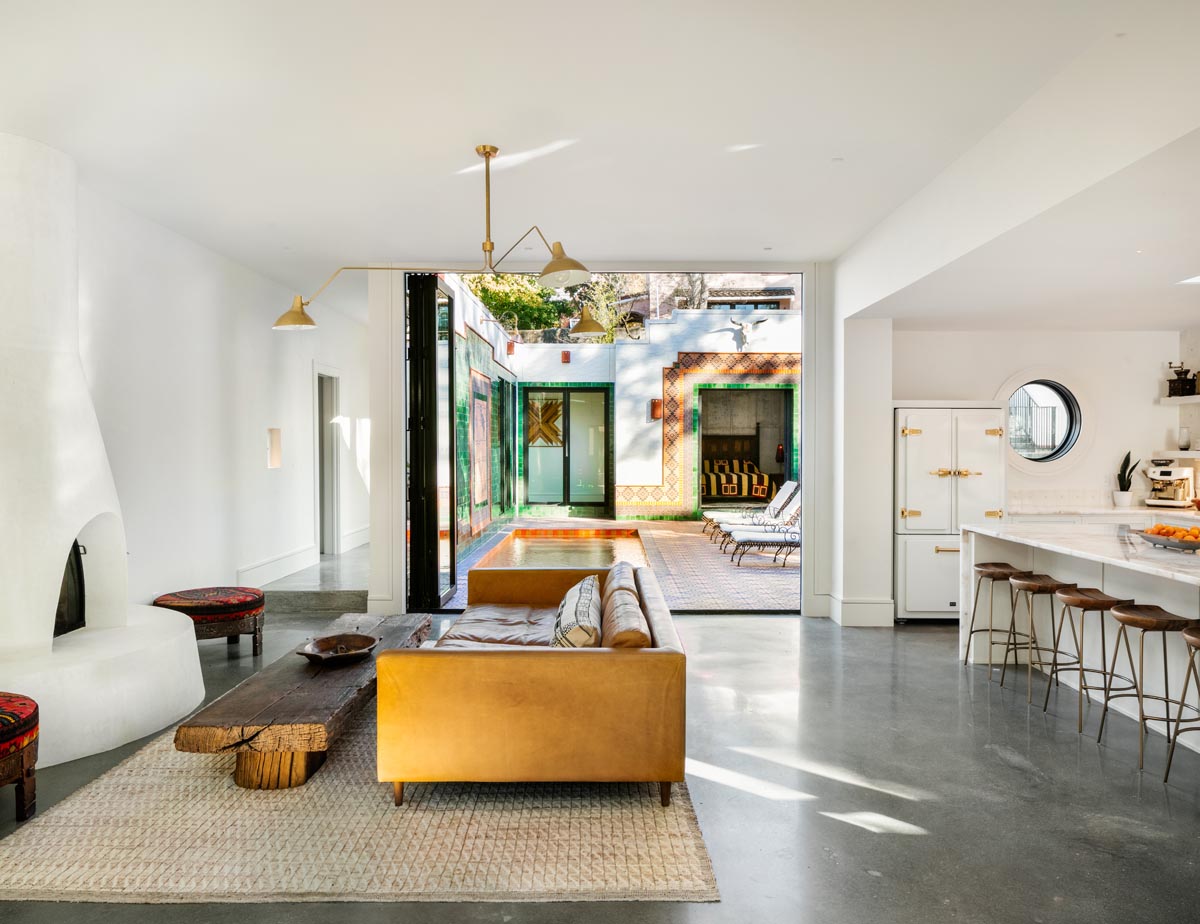
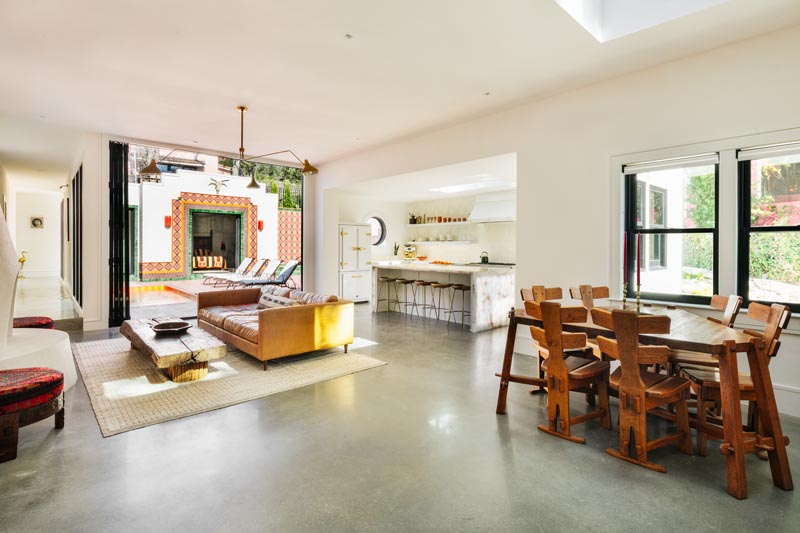
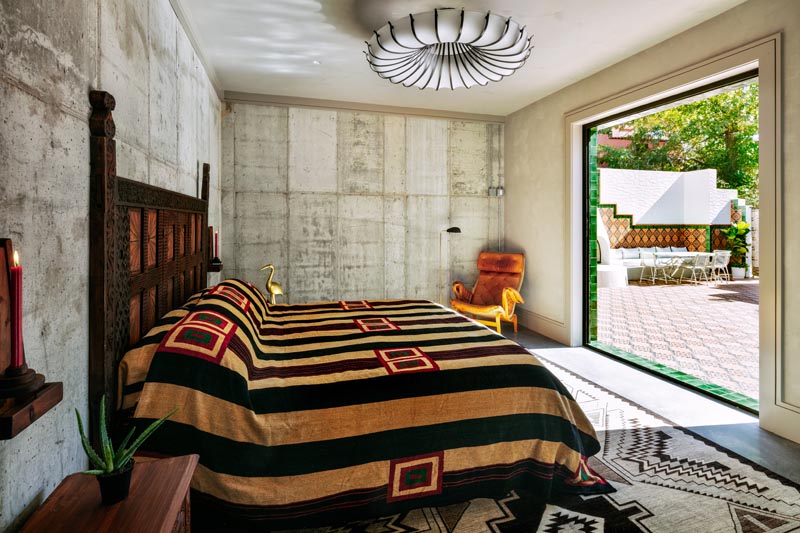
Unapologetic maximalism marks most of Porter’s designs, but for the interior of the Ziggurat House, he pictured something different: a clean, calm Zen retreat, in the vein of producer Rick Rubin’s famously placid Shangri-La studio. That meant polished concrete, white walls, space for sunlight to carry, and custom tiles that pushed the concept of subtlety to an unexpected edge.
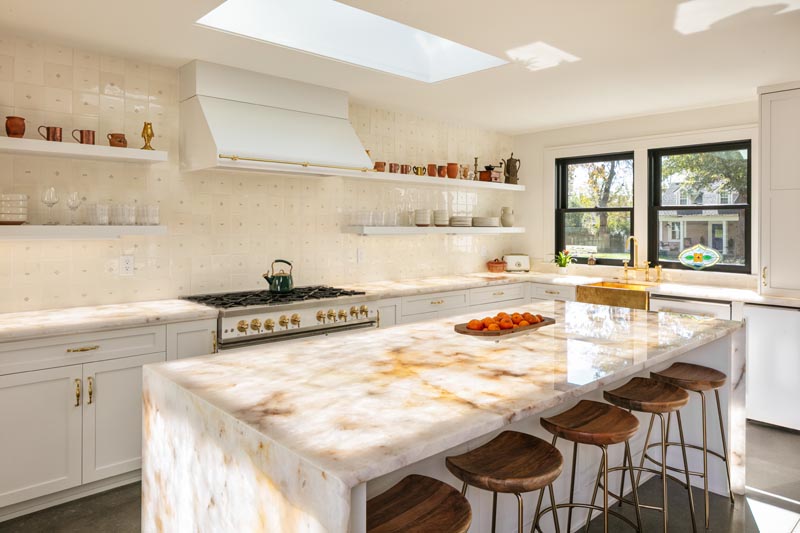
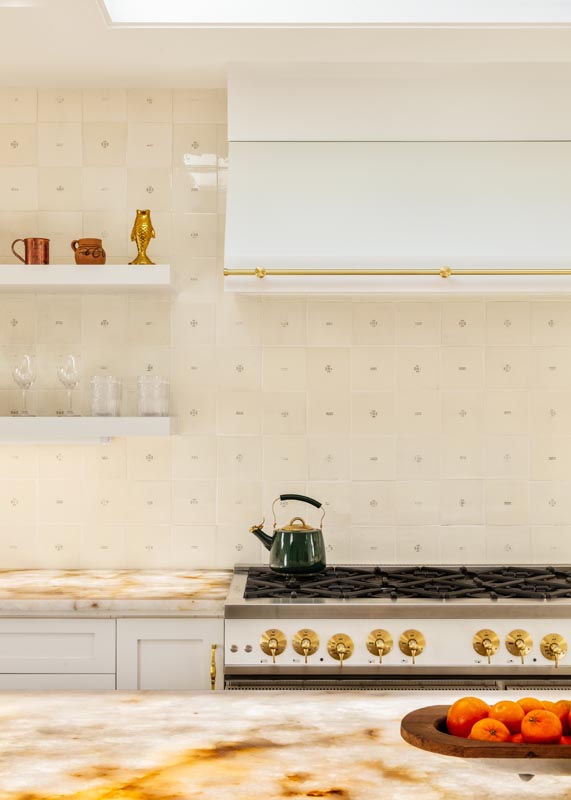
From a distance, square white kitchen and bath tiles in the Ziggurat House seem unassuming. Move closer, and you catch the imprints of Porter’s personal jewelry collection.
“It’s just a slight indention into the surface of a hand-cut tile,” Sheets says. “And then we did a black rub of stain, so the patina kind of showed the rubbing of the surface, similar to the way jewelry will patina and tarnish with time.”
Classics with a twist aren’t unusual for Red Rock — browse just their Field Tile selection and you’ll notice that each tile has its own identity, an artful individuality that flows out into a bolder whole. The human touch is what creates that dynamic variation, and “it’s something a machine can’t really reproduce,” Sheets says.
“When you buy a tile from a box store or a typical producer, really, you’re the first hands to touch it. It’s a powder clay body put into a metal mold that’s stamped, flipped onto a conveyor belt and fed through a kiln and automatically sprayed and boxed.… With ours, typically 14 hands touch a tile before you do.”
Tile-making by hand — glazing in particular — has its overlaps with jazz too, since there’s a flow and feel you have to get in step with.
“One of the things I always ask when I hire someone to glaze is, ‘Are you a good dancer, or can you play an instrument?'” Sheets says. “Because if you have rhythm, I can teach you how to spray. If you don’t have rhythm, it’s gonna be a real uphill battle.”
Going All Out
Visual restraint might’ve been atypical for Porter, but inside the Ziggurat House, it was less an uphill battle, more a fresh genre to explore.
“I was so inspired,” he says. “It was actually freeing.”
Still, an artist has to play the hits. And the courtyard is where Lyon Porter let his maximalism fly.
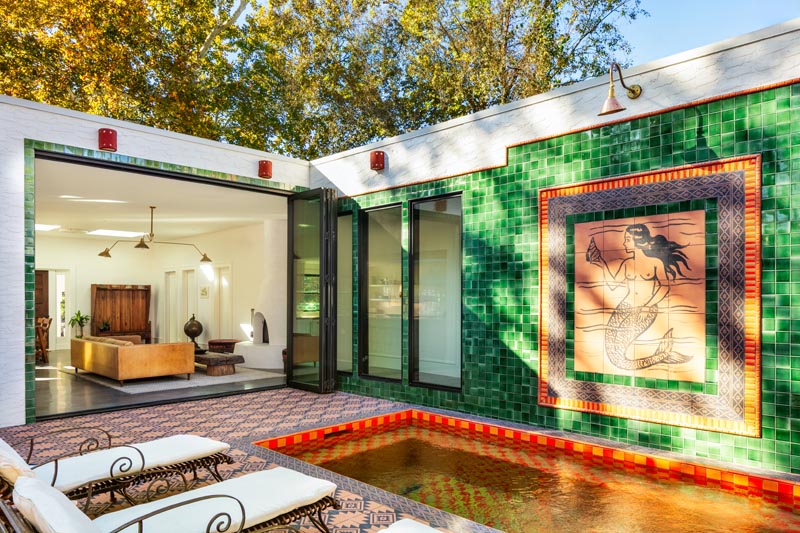
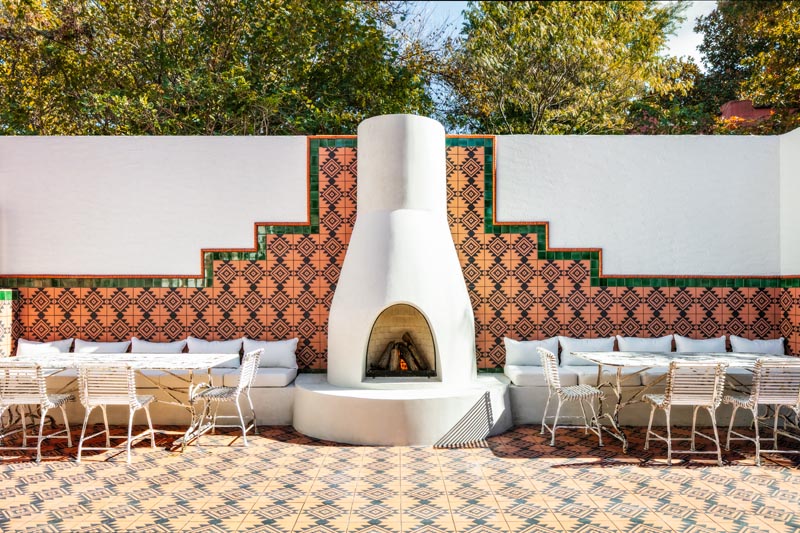
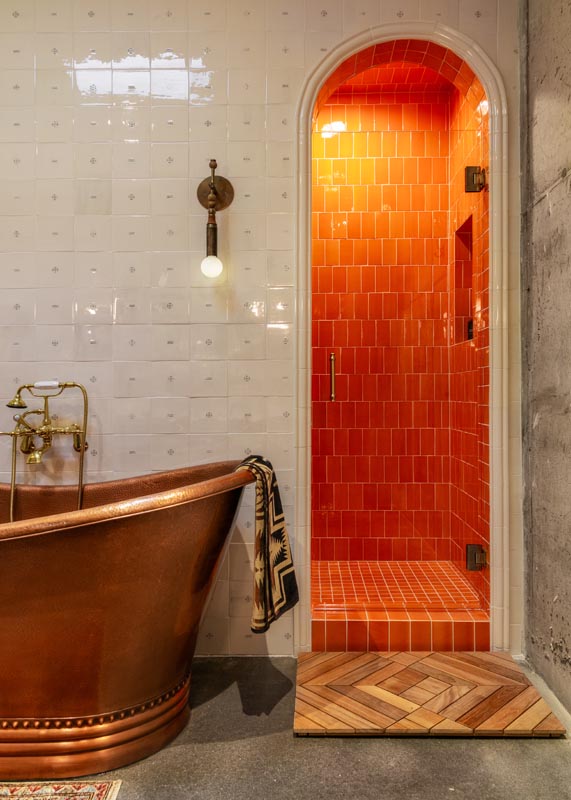
The house’s “jewel box,” as Sheets calls it, the courtyard both anchors the Zen and elevates the energy. In the center, a stair-stepped salt-water pool tiled in vibrant burnt orange grabs focus, before an expanse of boldly patterned tile pulls the eye outward. Those repeated shapes draw inspiration from the home’s original facade, where stepped tiers — a nod to ancient Mesopotamian ziggurats, where people “communed with the divine,” Porter says — flank the loggia.
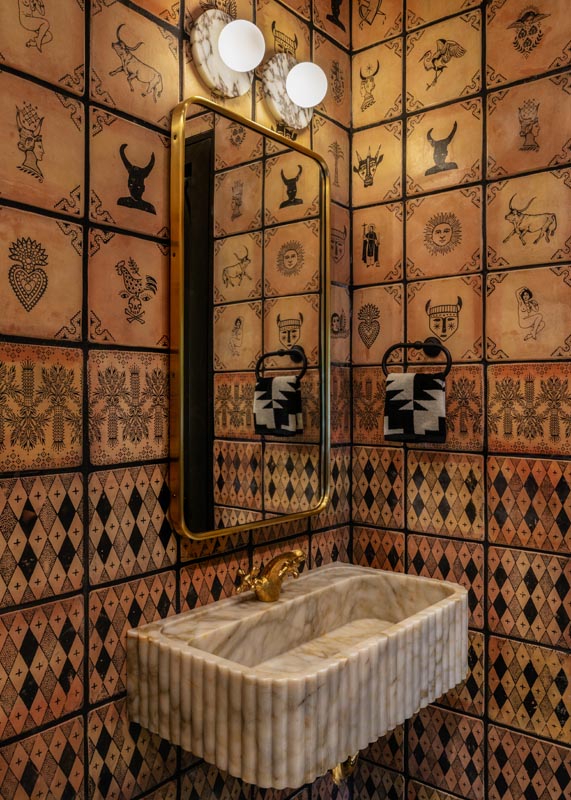
Beside the pool, a feature wall surrounded in jeweltone green holds a massive mermaid mural, hand-painted by New Orleans tattoo artist Pauly Lingerfelt. (His tattoo flash designs adorn screenprinted tiles inside, too.)
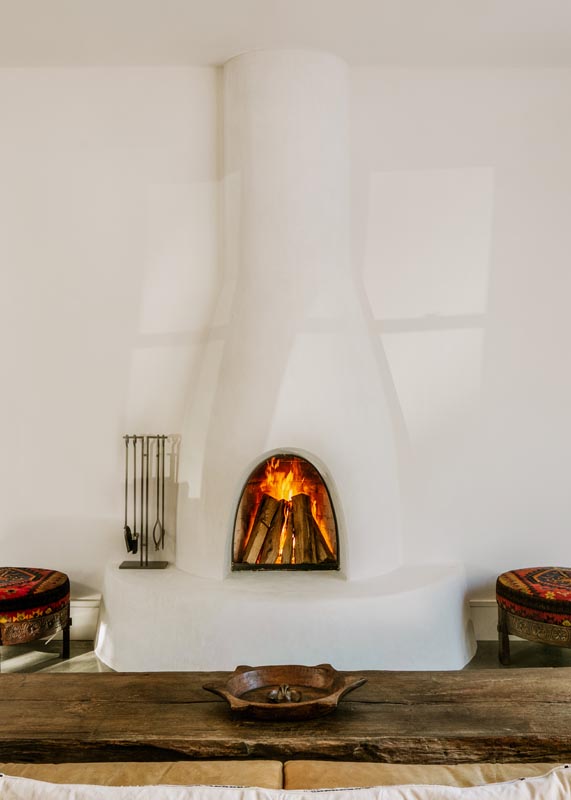
On the far wall, the patterned tiles climb behind one of the home’s two white kiva fireplaces, right beside what turned out to be the project’s toughest transition, by a mile.
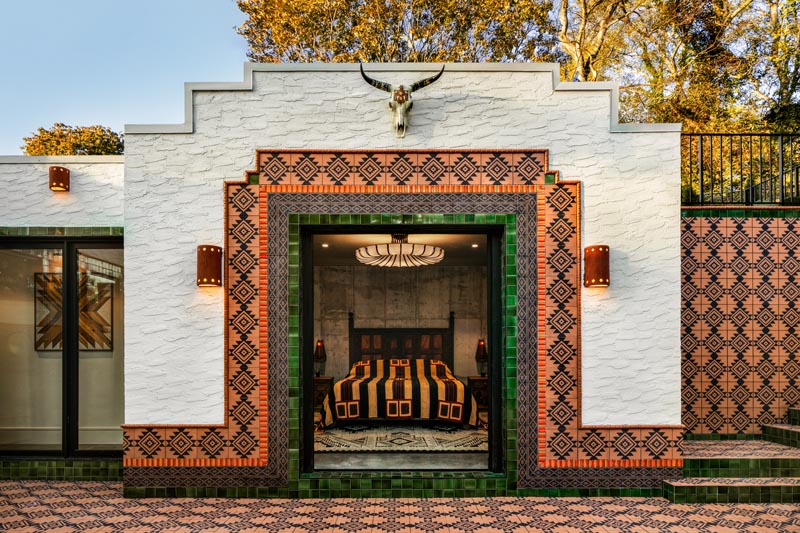
“The surround of the door to the primary suite — we were so stuck,” Porter remembers, “because we’re mixing one, two, three, four, five different tile patterns. And then they all had to be contextual to the rest of all this and match in with a burnt orange pool.”
They burned a good four months, Porter says, cycling through combinations. But those months mattered — details make all the difference when you’re determined to design a piece of art.
“Because this can go horribly wrong,” Porter says. “Like, this was extremely not safe.”
All in the Details
Like most Lyon Porter design details, the complexity in the finished five-tile surround harmonizes. You don’t sense the struggle, just the wow. And like all Porter projects, the Ziggurat House’s design didn’t exist until it did.
Porter doesn’t sketch or mock up a space in 2D to make completion quick and pre-plotted. He thinks, feels, and shapes it all in situ.
“I collect found objects,” Porter says. “They always have a story. And again, a collage artist, right? So I take all the pickings like a collage, and then I put them out there.”
He’s a know-it-when-I-see-it kind of designer. But when Porter sees it, he really sees it — with 20/10 vision, twice as sharp as the norm, he catches details and discrepancies most wouldn’t, almost down to the millimeter.
“I drive everyone crazy,” Porter says, laughing, “because I know it if I see it instantly, and I know it if it’s wrong instantly. Like, for instance, if you’re standing in the kitchen (of the Ziggurat House), the center of the stove is exactly lasered to the center of the fireplace, which is also the center of the island, which also has a skylight over it. I walked in, and they’d framed it in with sheet rock, and the skylight was half an inch off. I saw it from across the room.”
Porter designs in “symmetrical vignettes,” so precision is essential — not something he’ll compromise on. During the renovation, ceilings were mistakenly framed and finished at nine feet instead of 10. It threw off the symmetry, so they had to be torn out and redone.
“That’s how I find beauty, through symmetry,” Porter says. “In terms of eye travel, you’re trying to always let your eye land on something, and then have another layer, then another layer.”
Changing Hands
After years of commitment and collaboration, when the Ziggurat House was finally complete, Porter wasn’t sure he wanted to or could give it up. But the house was listed in March, and within hours, the house attracted its own kind of symmetry.
A Grammy-nominated, ACM-winning Nashville songwriter who’d recorded at Rubin’s Shangri-La walked in and felt the vibe and inspiration immediately. She wasn’t even planning to buy a place in Nashville — a property in New York was more likely — but in a moment, everything lined up.
“It’s poetic that it went to a musician,” Porter says, excitedly unfurling a vintage textile piece he just picked up in Santa Fe for the Ziggurat House’s new steward. “Like, who else would have gotten that thing?”